
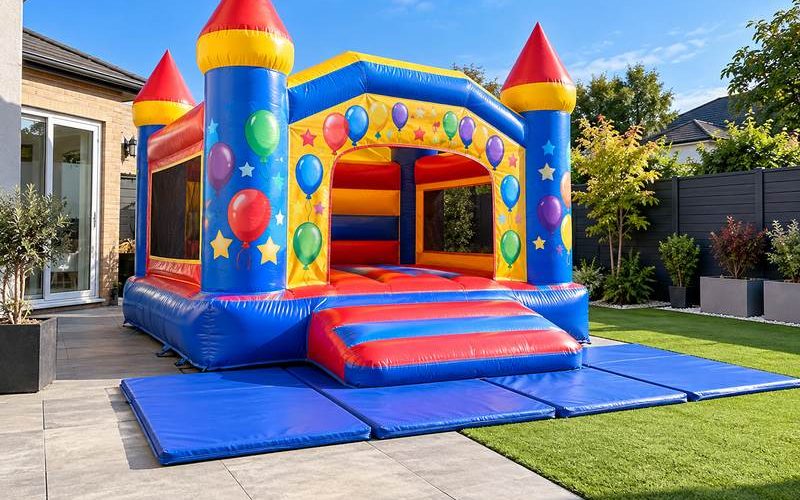
Grass is often the first choice for setting up a bouncy castle, but not every garden has a traditional lawn. Many homes across London and the UK now have artificial grass, paved patios or concrete surfaces, which can make arranging a children’s party a little more complicated.
A common question for parents is whether a bouncy castle can be installed on these surfaces without damaging the garden or compromising safety.
The short answer is yes, in some circumstances. However, the type of surface affects how the inflatable must be anchored, what protective equipment may be required and whether the location is suitable in the first place.
Before booking, it is worth understanding why some hire companies accept hard-surface installations while others only operate on natural grass.
Natural Grass, Artificial Grass and Concrete: What’s the Difference?
Although a bouncy castle may look the same once inflated, the ground beneath it can make a considerable difference to installation.
Natural grass generally allows suitable ground stakes to be driven into the soil, provided the ground conditions are appropriate. These stakes help hold the inflatable securely in position.
Concrete and paving don’t usually allow conventional staking. Alternative anchoring arrangements are therefore necessary.
Artificial grass falls somewhere between the two. Its suitability depends largely on what lies underneath it.
| Surface | Main consideration | Possible installation approach |
|---|---|---|
| Natural grass | Suitable soil and anchoring conditions | Ground stakes where appropriate |
| Artificial grass | Type of sub-base beneath the lawn | Suitable stakes or approved alternative anchoring |
| Concrete | No conventional ground staking | Properly designed ballast or suitable fixed anchors |
| Paving slabs | Stability, level ground and anchoring | Site-specific hard-standing arrangements |
None of these surfaces is automatically suitable. A competent operator must consider the inflatable’s instructions, the available space and the proposed anchoring system.
Using a Bouncy Castle on Concrete
A concrete area may appear ideal because it is firm, level and easy to access. However, securing the inflatable is usually the biggest challenge.
Outdoor commercial bouncy castles must be properly anchored to prevent unwanted movement, particularly in windy conditions.
On natural grass, ground stakes are often used. On concrete, suitable alternative arrangements are needed.
The UK Health and Safety Executive (HSE) provides guidance on securing play inflatables where stakes cannot be used. Its guidance refers to suitable ballast of at least 163kg per anchor point, or appropriately specified and installed ground anchor bolts.
This is an important distinction. A few lightweight sandbags placed around the inflatable are not equivalent to a suitable hard-standing anchoring system.
The installation also needs to account for the hard ground around the equipment.
Protecting Children from Hard Surfaces
Concrete offers little protection if a child falls while entering or leaving a bouncy castle.
Depending on the equipment and its layout, appropriate impact-absorbing matting may be required at entrances, exits or other areas where a fall could occur.
A groundsheet beneath the inflatable can help reduce abrasion, but it should not be mistaken for impact-absorbing safety matting.
The two serve different purposes.
Some hire companies choose not to install bouncy castles on concrete because the necessary anchoring and protection arrangements aren’t practical for their equipment.
For parents, it is always better to confirm this before booking rather than assume a hard-standing installation will be available.
What Makes Artificial Grass Different?
Artificial grass is increasingly common in modern gardens, particularly where homeowners want a tidy lawn throughout the year without regular mowing.
It may look similar to natural grass, but the construction underneath can be completely different.
Some artificial lawns are laid over compacted stone or aggregate. Others may sit above concrete, paving or another prepared base.
This matters because the visible surface doesn’t establish whether ground stakes can be installed safely.
If the underlying ground is suitable, an operator may be able to use appropriate stakes, subject to site conditions and the manufacturer’s requirements. Where staking is not possible, a suitable alternative anchoring system would be necessary.
Artificial grass itself does not hold a bouncy castle in place.
There is also the question of damage.
An inflatable may flatten or disturb the grass fibres, while dragging heavy equipment across the lawn can cause abrasion. Ground stakes may leave holes, and prolonged pressure could affect some installations.
A protective groundsheet may help reduce surface wear, but it cannot guarantee that the lawn will remain unaffected.
If your artificial grass was professionally installed, checking the supplier’s care instructions before arranging a bouncy castle is sensible.
Why Anchoring Is More Important Than the Surface Itself
It is easy to focus on whether the ground is soft, hard or artificial. However, the most important issue is whether the inflatable can be secured correctly.
A commercial bouncy castle can experience substantial wind forces, even when children are not using it.
Every required anchoring point needs to be secured using a suitable method.
Placing a few bags of sand beside an inflatable, tying it to a garden fence or attaching it to outdoor furniture should not be treated as an acceptable substitute for a properly assessed anchoring arrangement.
The Professional Inflatable Play Association (PIPA) also provides guidance on hard-standing installations, including the importance of suitable ballast and secure attachment arrangements.
For outdoor use, operators need to consider both the inflatable manufacturer’s instructions and the relevant UK safety guidance.
The HSE states that outdoor play inflatables must not be used when wind speeds exceed 24mph. A manufacturer may specify a lower limit, which must be followed.
Wind conditions should be monitored using a suitable anemometer rather than judged solely by how calm the garden feels.
Correct anchoring does not remove the need to stop use when weather conditions become unsafe.
A Patio or Driveway May Not Be as Suitable as It Looks
Concrete is not the only hard surface that requires careful assessment.
Many London gardens have paved patios, narrow side passages or small driveways. These areas may seem convenient, but space and surrounding obstacles can create additional restrictions.
An inflatable needs sufficient clearance around it, not just enough room for its main dimensions.
Walls, fences, steps, parked vehicles and overhead obstructions may all affect whether the equipment can be installed.
Uneven paving or sloping ground can also create problems.
A particularly common mistake is measuring only the inflatable itself. A castle advertised as fitting within a certain footprint may still need additional space for its blower, inflation tubes, anchoring arrangements and safe access.
For this reason, a hire company may decline a location even when the castle appears to fit.
Choosing a smaller model might help with space restrictions, but it will not remove the need for correct anchoring and safe operating conditions.
Before Booking: Give Your Hire Company the Right Information
You don’t need to know the technical details of an anchoring system before hiring a bouncy castle. That is the responsibility of the competent operator.
However, giving the company accurate information about your garden can prevent problems on the day.
It is useful to provide:
- The type of surface and, for artificial grass, what is underneath it if known.
- The approximate length and width of the available area.
- Any slopes, steps, walls, fences or other nearby obstacles.
- Photographs showing the proposed installation location.
- Details of access routes, particularly narrow gates or passages.
If your garden has a mixture of natural grass and paving, explain the layout rather than simply describing it as a grass garden.
The operator can then advise whether the proposed location is suitable and what arrangements would be needed.
In some cases, positioning the castle on a different part of the garden may make installation more straightforward.
Choosing the Best Surface for Your Event
For many outdoor parties, suitable natural grass remains the simplest option because conventional ground anchoring may be possible.
Artificial grass can sometimes accommodate a bouncy castle, but the underlying construction and potential for surface damage need attention.
Concrete and paving can also be suitable where the operator has the equipment, expertise and appropriate anchoring arrangements for hard-standing installations.
The choice should never be based solely on whether the inflatable fits within the available space.
When planning a children’s birthday party, school celebration or community event, discussing the ground conditions with the hire company early can help avoid unexpected installation problems.
A properly installed bouncy castle should remain securely anchored, have appropriate clearance and be operated within its specified limits.
Whether your garden has natural grass, artificial turf or concrete, the right location is the one where those safety requirements can be met—not simply the area with the most available space.