
Not every bouncy castle is suitable for every child. Some are designed for younger children, while others can accommodate taller users or even adults. The differences aren’t always obvious from the outside, especially when two inflatables look similar in size.
Commercial bouncy castles have specific operating limits to help prevent overcrowding, collisions and inappropriate use. These restrictions are based on the equipment’s design and intended users, rather than simply how large the castle appears.
For parents organising a party and businesses operating inflatable attractions, understanding these limits is an important part of choosing and using equipment safely.
Why Height Matters More Than Age
Age is often the first thing parents consider when choosing activities for children. However, it isn’t always the most reliable way to determine whether someone is suitable for a particular bouncy castle.
Two children of the same age can differ considerably in height and physical size. That’s why commercial inflatables commonly use maximum user height as an important operating restriction.
A smaller castle may have protective walls, entrances and other features designed around a particular range of user heights. Allowing taller participants onto the equipment could introduce risks that weren’t accounted for in its design.
The manufacturer’s maximum height limit should therefore be followed, even if an older child appears capable of using the inflatable comfortably.
In the UK, the Health and Safety Executive (HSE) specifically advises operators not to exceed user height limits and to keep larger users separated from smaller ones.
These restrictions should be available in the equipment’s operating instructions and relevant safety information.
How Do Weight Limits Work?
Weight restrictions are another important consideration, although they are not the same as height limits.
A bouncy castle is subjected to changing forces while people jump, land and move across the inflatable surface. These movements create different demands from those produced by people standing still.
The construction must therefore be suitable for the intended activities and users.
Some inflatable equipment has specified individual or total weight limits. Where these are provided, they must be followed alongside any height and capacity restrictions.
However, weight alone doesn’t determine whether someone can safely use a castle.
A child may fall below a stated weight limit but still exceed the permitted height. Similarly, the combined weight of several children doesn’t automatically establish how many should be allowed onto the inflatable.
For the standard commercial bouncy castles commonly used at UK events, user height and the permitted number of participants are particularly important.
Rather than relying on a general weight estimate, organisers should use the limits stated for the specific inflatable.
Why Does the Number of Users Vary?
A castle’s maximum capacity isn’t always one fixed number for every group of children.
The number of participants permitted may depend on their height, with taller users generally requiring more space to bounce safely.
This is because children don’t remain in one position. They jump, turn, change direction and sometimes move towards the same area at once.
The usable bouncing space must accommodate this movement without excessive overcrowding.
For example, a commercial castle may be rated for a certain number of smaller children but fewer taller children. The exact figures depend on its design and the information supplied by the manufacturer.
An operator should never assume that a capacity advertised for younger children also applies to teenagers or larger users.
It is also important to distinguish between the inflatable’s external dimensions and its actual play area.
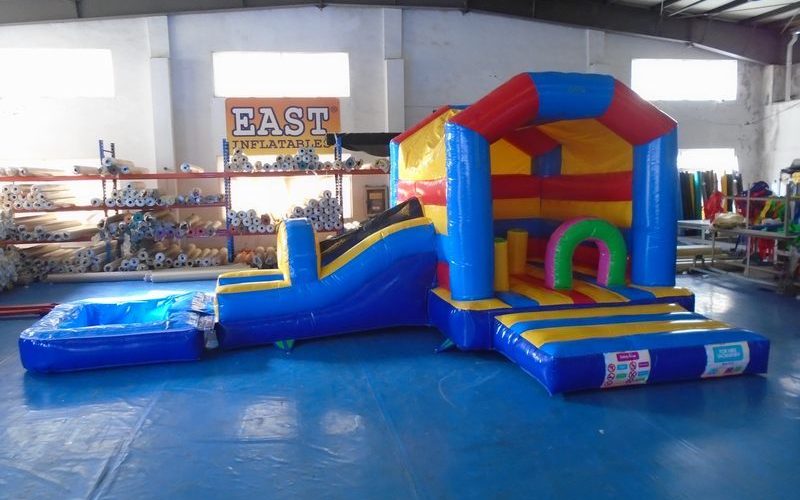
A combination castle with a slide might look larger than a traditional castle, but part of its footprint is occupied by the climbing and sliding sections.
A bigger inflatable does not necessarily mean a higher permitted user capacity.
Why Should Larger and Smaller Children Be Separated?
One of the main reasons for controlling user size is to reduce the risk of collisions.
When children bounce together, their movements affect the inflatable surface and other participants. A larger child may unintentionally knock a smaller child off balance, particularly during energetic play.
The difference in size can also make accidental contact more hazardous.
At an event where toddlers and older primary school children are attending, separate play sessions may be a practical solution.
This allows children of similar sizes to enjoy the inflatable together, provided they remain within the equipment’s permitted user limits.
Supervision remains essential. Even a group of similarly sized children can become overcrowded or engage in unsafe play.
The operator should monitor behaviour, control the number of participants and intervene when necessary.
These measures are not intended to make bouncing less enjoyable. They help create a more suitable playing environment for everyone.
Can Adults Use a Commercial Bouncy Castle?
Some commercial inflatable attractions are designed to accommodate adults, but many children’s bouncy castles are not.
An inflatable’s large appearance or reinforced construction doesn’t automatically make it suitable for adult users.
Adult-rated equipment must be designed and specified for the intended participants and activities.
This is particularly relevant at weddings, corporate family days and community celebrations where adults may want to join in.
Before booking, organisers should confirm whether the inflatable is suitable for adults and check any applicable height, weight or capacity limits.
Adults should not use a children’s castle simply because there appears to be enough room.
When a party includes both adults and children, separate equipment or appropriately organised sessions may be necessary.
What Should Parents Check Before Booking?
Parents don’t need to understand the engineering behind every inflatable, but they should know who the equipment is intended for.
When contacting a hire company, it is worth providing the approximate ages and heights of the children attending.
If older children or adults are expected, mention this before choosing a castle.
A responsible supplier should be able to explain the equipment’s user restrictions and recommend suitable options.
It’s also useful to establish how many participants can use the inflatable simultaneously and whether separate sessions will be needed.
For larger events, such as school fun days or community celebrations, organisers may find that two different attractions are more suitable than one castle intended to accommodate a wide range of participants.
The aim should be to choose equipment that matches the guests, rather than trying to make an unsuitable inflatable work for everyone.
The Importance of Supervision During Use
Even when the correct inflatable has been selected, operating limits still need to be managed throughout the event.
A suitably trained supervisor should ensure that the number of users remains within the manufacturer’s restrictions.
Children should enter and leave in a controlled manner, and rough play, pushing and climbing on protective walls must be prevented.
The UK HSE advises that play inflatables should be supervised at all times by suitably trained personnel. The number of supervisors required depends on the equipment, its operating instructions and the conditions of use.
For busy events, a clear system for taking turns can help prevent children from entering an already full castle.
If the play area becomes overcrowded or participants are behaving unsafely, the supervisor should intervene.
Correct installation, anchoring and inflation pressure are equally important, but none of these measures replaces effective control of the users.
Why Following the Manufacturer’s Limits Matters
It’s easy to focus on the appearance of a bouncy castle when planning a party. Colourful designs, slides and themed features naturally attract attention.
However, the information that matters most for safe use is often less visible.
Maximum user height, permitted capacity and any applicable weight restrictions are specific to the inflatable’s design and intended use.
These limits should not be increased simply because the equipment appears sturdy or there is room for another participant.
For parents, the best approach is to choose an inflatable suitable for the children attending. For operators, it means following the manufacturer’s instructions, organising play appropriately and maintaining effective supervision.
A well-run bouncy castle event isn’t about allowing the greatest possible number of people to bounce at once. It’s about giving participants enough space to enjoy the activity within the equipment’s safe operating limits.