
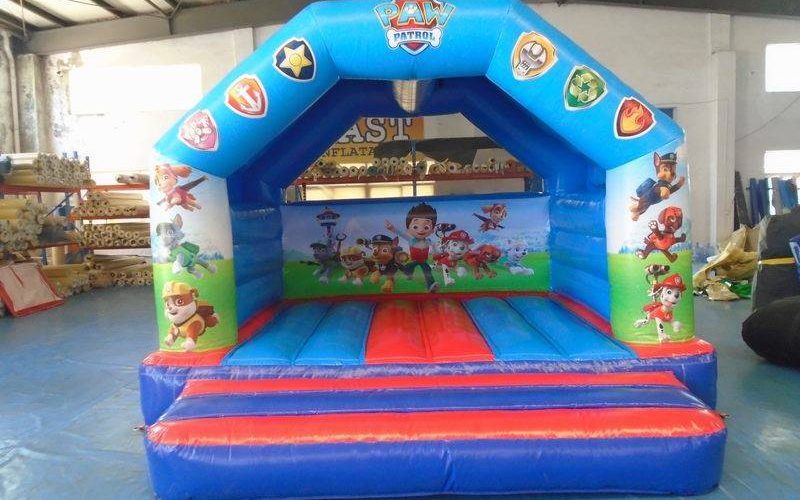
If you’ve ever compared different bouncy castles, you may have noticed that some have colourful roofs while others are completely open at the top. Although both designs provide similar bouncing activities, their structures can affect shade, visibility and suitability for different venues.
Roofed and open-top bouncy castles are commonly used at children’s birthday parties, school fetes and community events across the UK. Each has its advantages, and the best choice depends on where the inflatable will be used and the type of event you’re planning.
A roofed bouncy castle can provide shade and a more enclosed play environment, while an open-top design offers a greater sense of space and may be easier to accommodate in certain venues.
Understanding these differences can help you choose a suitable inflatable without relying on appearance alone.
What Is the Difference Between Roofed and Open-Top Bouncy Castles?
A roofed bouncy castle has an overhead cover supported by its inflatable structure. Depending on the model, this may be a fabric canopy, an inflatable arch or a decorative roof incorporated into the overall design.
Some roofs cover most of the bouncing area, while others provide only partial coverage.
An open-top bouncy castle has no overhead canopy above its main jumping area. It still has protective side walls and designated access points, but the upper section remains open.
Both types can be suitable for commercial use when properly designed, manufactured and operated.
The main differences involve shade, visibility, overhead space and the overall playing environment.
Why Do Some Bouncy Castles Have Roofs?
Manufacturers include roofs for several practical and decorative reasons.
Providing Shade on Sunny Days
One of the main advantages of a roofed bouncy castle is the shade it can provide.
During warm summer events, an overhead cover may reduce direct sunlight reaching the bouncing surface, making the play area more comfortable.
This can be useful for outdoor birthday parties and family celebrations.
However, a roof doesn’t guarantee cooler conditions. Dark-coloured surfaces, limited airflow and high temperatures can still make an inflatable uncomfortable.
Children should have regular breaks and access to drinking water during warm weather, regardless of the castle’s design.
Creating Different Themes and Designs
Roofs can also play an important role in the appearance of a bouncy castle.
A traditional castle design may feature a roof with decorative towers, while jungle-themed inflatables might incorporate colourful arches or canopy-like structures.
These features help create a particular visual style and can make the inflatable more appealing for themed celebrations.
Some roof designs also provide a more enclosed atmosphere, which may suit certain types of play equipment.
However, decorative features should never interfere with the inflatable’s safe operation or supervision.
Offering Limited Shelter
Some roofed bouncy castles feature overhead covers that can help shield the bouncing area from direct sunlight.
However, these covers should not be treated as rain protection unless the manufacturer specifically permits such use. Wet surfaces can become slippery, and outdoor operation must always follow the equipment’s weather restrictions.
Even when a roof covers most of the bouncing area, rain may still enter through openings or collect on parts of the structure.
A roof should never be treated as a reason to ignore unsafe weather conditions.
What Are the Advantages of Open-Top Bouncy Castles?
Open-top inflatables offer a different playing environment and can be practical in several situations.
A More Open Playing Area
Without an overhead cover, children may experience a greater sense of space while bouncing.
This can be appealing at outdoor events where an open, colourful inflatable fits naturally into the surroundings.
An open-top castle has no overhead canopy restricting the space above the bouncing area. However, actual ventilation depends on the overall design, including the height of the walls and the size and position of any mesh openings.
Visibility for Supervisors
Good visibility is essential when children are using inflatable play equipment.
Some open-top castles allow supervisors to observe the play area more easily, particularly when the surrounding walls are relatively low.
However, visibility depends on the entire design.
A roofed castle with large mesh panels may provide excellent views of the bouncing area, while an open-top model with tall walls can still have blind spots.
When choosing an inflatable, consider whether supervisors can clearly observe the children rather than assuming one roof style is always better.
Flexibility for Different Venues
Some open-top castles have fewer overhead structural features, which may make them suitable for certain indoor spaces.
However, the absence of a roof doesn’t automatically mean the inflatable is shorter.
An open-top castle may be suitable for venues with limited ceiling height, but only when its actual dimensions and required overhead clearance allow safe installation. A low-height roofed model may sometimes fit better than a taller open-top design.
The actual dimensions and installation requirements are more important than the roof style alone.
Are Roofed Bouncy Castles Safer in Bad Weather?
A roofed inflatable is not necessarily safer than an open-top castle during poor weather.
Although a canopy may provide shade, it doesn’t remove the risks associated with strong winds, heavy rain or unsuitable ground conditions.
Roofed and open-top designs can react differently to wind because their shapes and exposed surfaces vary.
For this reason, operators must follow the specific equipment’s weather restrictions.
The UK Health and Safety Executive (HSE) states that play inflatables must not be operated in winds above 24 mph (approximately 38 km/h), and some models have lower permitted limits.
Outdoor operators should monitor local wind conditions using a suitable anemometer rather than relying solely on weather forecasts.
Correct anchoring, inflation pressure and supervision are essential for both designs.
Whether a castle has a roof or not, play must stop whenever conditions exceed the equipment’s safe operating limits.
Which Design Is Better for Indoor Parties?
Both roofed and open-top bouncy castles can be suitable for indoor use, provided the venue meets the manufacturer’s installation requirements.
For smaller community halls, an appropriately sized open-top model may be convenient if it has a lower overall height.
Roofed castles can also work indoors, particularly when designed with compact structures or low-height canopies.
Ceiling beams, lighting fixtures, ventilation equipment and other overhead obstructions can reduce the usable height.
Before booking, measure the venue carefully and confirm the complete installation dimensions with the hire company.
Floor conditions, electricity, anchoring arrangements and access must also be suitable.
Does a Roof Affect Ventilation?
Roof design can influence how air moves around the children’s play area.
An open-top castle has no overhead canopy, while a roofed castle may create a more sheltered environment.
However, many roofed designs include mesh walls or large openings that allow natural ventilation and visibility.
The overall structure matters more than the presence of a roof alone.
It’s also important to distinguish ventilation from the air supply used to inflate the castle.
Most commercial bouncy castles operate using a continuously running electric blower. This maintains the internal pressure needed for the inflatable to hold its shape.
Whether the castle has a roof or an open top, the blower must operate according to the manufacturer’s instructions.
How Should You Choose Between the Two Designs?
The best option depends on your event, venue and intended users.
For outdoor summer celebrations, a roofed castle may be appealing because of the shade it provides.
For an indoor party with limited ceiling height, a suitably sized open-top model may be more practical.
At larger school or community events, either design can work well when it provides appropriate visibility, user capacity and installation arrangements.
Before making a decision, consider the following:
- Available space: Does the inflatable fit with the required clearances?
- Weather conditions: Is the equipment suitable for the planned environment?
- Visibility: Can supervisors clearly monitor the play area?
- User suitability: Does the castle meet the children’s height and capacity requirements?
- Safe installation: Can it be properly secured and operated at the venue?
A professional hire company should be able to recommend suitable equipment based on these considerations.
Final Thoughts
Roofed and open-top bouncy castles offer different advantages, but neither design is automatically better for every event.
A roofed castle can provide shade and contribute to a themed appearance, while an open-top castle offers a more open playing environment and may suit certain indoor spaces.
The choice should ultimately depend on the venue, intended users, equipment dimensions and safe operating requirements.
By looking beyond appearance and considering these practical differences, families and event organisers can choose a bouncy castle that fits their needs and provides an enjoyable experience for children.